
Is It a Carb, Protein, or Fat? The 5 Foods We Get Confused About Most
Are you ever confused about where foods like nuts, hummus, cheese, seeds, or olive oil fit into a healthy eating plan, and how much is actually considered a serving?
You're not alone!
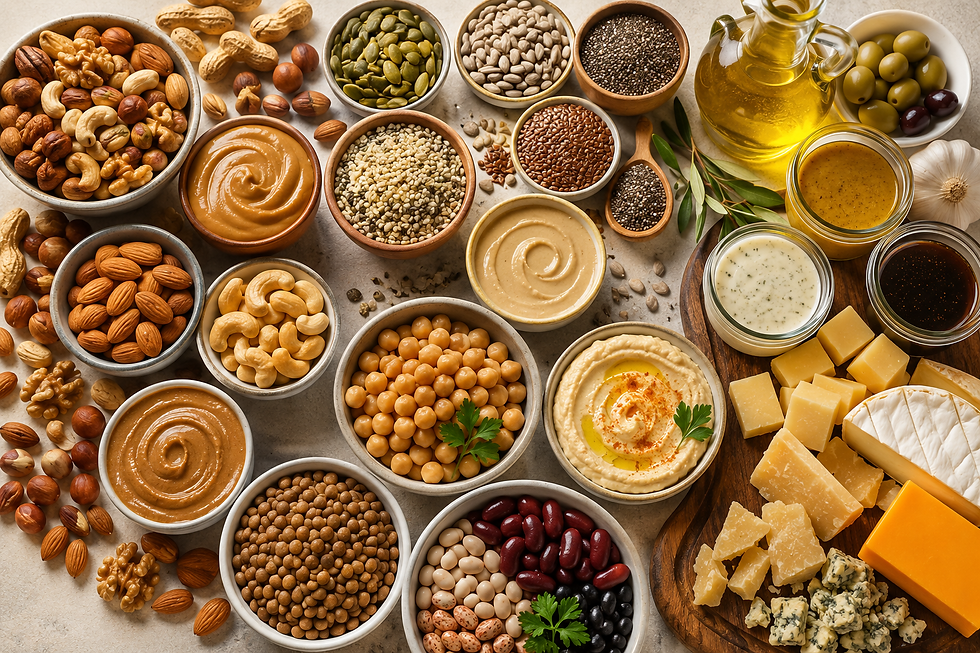
As a Registered Dietitian, one of the most common questions I hear from clients is, "What exactly does this food count as?" Nuts, hummus, beans, cheese, seeds, and olive oil are all incredibly nutritious foods, but they can also be some of the most misunderstood.
Many foods contain a combination of carbohydrates, protein, and fat. While that's one of the reasons they're so nutritious, it can also make portions and meal planning more confusing.
My approach is that there are no forbidden foods. However, understanding where foods "live" on your plate can help create more balance and make it easier to align your meals with your weight, cholesterol, blood sugar, and health goals.
A simple rule I teach clients is this: Every food contains a mix of nutrients. But ask yourself: Where does most of the energy come from?
Let's break down the five foods that create the most confusion and settle the debate once and for all.
1. Nuts & Nut Butters
Standard Serving
¼ cup nuts
2 tbsp nut butter
Where Does Most of the Energy Come From?
Nutrient | Approximate Contribution |
Fat | 70–80% |
Protein | 10–20% |
Net Carbohydrate | 5–15% |
🏆 Winner: Nuts / Nut Butters = Fat
This is one of the biggest areas of confusion. Nuts grow from plants and contain protein, fibre, vitamins, and minerals, so many people think of them as a protein food.
However, most of the calories come from fat.
Typical Nutrition Per Serving
Food | Serving | Calories | Fat (g) | Sat Fat (g) | Protein (g) | Fibre (g) |
Almonds | ¼ cup | 200 | 18 | 1.4 | 7 | 4 |
Cashews | ¼ cup | 190 | 15 | 3 | 5 | 1 |
Pistachios | ¼ cup | 170 | 13 | 1.5 | 6 | 3 |
Peanuts | ¼ cup | 210 | 18 | 2.5 | 9 | 3 |
Walnuts | ¼ cup | 190 | 19 | 1.8 | 4.5 | 2 |
Peanut Butter | 2 tbsp | 190 | 16 | 3 | 8 | 2 |
Almond Butter | 2 tbsp | 190 | 18 | 1.5 | 7 | 3 |
Cashew Butter | 2 tbsp | 180 | 15 | 3 | 5 | 1 |
Takeaway
Think of nuts and nut butters as:
Healthy fats with bonus protein and fibre.
2. Seeds & Seed Butters
Standard Serving
2 tbsp chia, flax, or hemp seeds
¼ cup pumpkin or sunflower seeds
2 tbsp tahini or seed butter
Where Does Most of the Energy Come From?
Nutrient | Approximate Contribution |
Fat | 60–75% |
Protein | 10–25% |
Net Carbohydrate | 5–15% |
🏆 Winner: Seeds / Seed Butters = Fat
While seeds often contain more protein than nuts, most still derive the majority of their calories from fat.
Typical Nutrition Per Serving
Food | Serving | Calories | Fat (g) | Sat Fat (g) | Protein (g) | Fibre (g) |
Chia Seeds | 2 tbsp | 140 | 9 | 1 | 5 | 10 |
Ground Flax | 2 tbsp | 75 | 6 | 0.5 | 3 | 4 |
Hemp Hearts | 2 tbsp | 120 | 10 | 1 | 7 | 1 |
Pumpkin Seeds | ¼ cup | 180 | 15 | 3 | 9 | 2 |
Sunflower Seeds | ¼ cup | 200 | 18 | 2 | 6 | 3 |
Tahini | 2 tbsp | 180 | 16 | 2 | 5 | 3 |
Takeaway
Seeds are nutritional overachievers, providing:
Fibre
Iron
Magnesium
Zinc
Omega-3 fats (chia and flax)
But nutritionally they function primarily as a fat source.
3. Beans, Lentils & Hummus
Standard Serving
½ cup cooked beans or lentils
3 tbsp hummus
Where Does Most of the Energy Come From?
(Using net carbohydrates, which subtract fibre.)
Nutrient | Approximate Contribution |
Net Carbohydrate | 40–50% |
Protein | 25–35% |
Fat | 10–20% |
🏆 Winner: Beans / Lentils / Hummus = Carbohydrate
This surprises many people.
Beans contain meaningful protein, but they still provide slightly more energy from carbohydrate than protein.
Typical Nutrition Per Serving
Food | Serving | Calories | Fat (g) | Sat Fat (g) | Protein (g) | Fibre (g) |
Chickpeas | ½ cup | 135 | 2 | 0.2 | 7 | 6 |
Black Beans | ½ cup | 115 | 0.5 | 0.1 | 8 | 8 |
Kidney Beans | ½ cup | 110 | 0.5 | 0.1 | 7 | 6 |
Lentils | ½ cup | 115 | 0.5 | 0.1 | 9 | 8 |
Hummus | 3 tbsp | 105 | 7 | 1 | 3 | 3 |
Why They're So Unique
Beans and lentils are one of the few foods that naturally provide:
✓ Protein
✓ Fibre
✓ Iron
✓ Magnesium
✓ Low glycemic carbohydrates
✓ Soluble fibre
The soluble fibre helps lower LDL cholesterol, supports gut health, and contributes to steadier blood sugars. Legumes are also a cornerstone of both the Mediterranean diet and the Blue Zones, regions associated with exceptional longevity.
Takeaway
Think of legumes as:
A carbohydrate with impressive protein and fibre built in.
This is one food group where I often tell clients that more is usually better.
4. Cheese
Standard Serving
30 g cheese
Approximately ¼ cup shredded cheese
Where Does Most of the Energy Come From?
Nutrient | Approximate Contribution |
Fat | 60–75% |
Protein | 25–40% |
Carbohydrate | <5% |
🏆 Winner: Cheese = Fat
Many people count cheese as protein.
In reality, most cheeses provide significantly more calories from fat than protein.
Typical Nutrition Per Serving (30 g)
Cheese | Calories | Fat (g) | Sat Fat (g) | Protein (g) | Fibre (g) |
Cheddar | 120 | 10 | 6 | 7 | 0 |
Mozzarella | 85 | 6 | 4 | 7 | 0 |
Feta | 75 | 6 | 4 | 4 | 0 |
Goat Cheese | 100 | 8 | 6 | 6 | 0 |
Parmesan | 110 | 7 | 4.5 | 10 | 0 |
Why Portion Matters
For many adults, a reasonable goal is keeping saturated fat intake below approximately 15–20 grams daily. Consider this:
30 g cheddar cheese = 6 g saturated fat
60 g cheddar cheese = 12 g saturated fat
That's already 60–80% of an entire day's target.
Takeaway
Cheese is best viewed as:
A fat source that happens to contain protein.
Think of it as a flavour enhancer rather than your primary protein source.
5. Oils, Dressings & Sauces
Standard Serving
1 tbsp oil
2 tbsp dressing
Where Does Most of the Energy Come From?
Nutrient | Approximate Contribution |
Fat | 90–100% |
Protein | 0–2% |
Carbohydrate | 0–10% |
🏆 Winner: Oils / Dressings / Sauces = Fat
This category is almost entirely fat.
Typical Nutrition Per Serving
Food | Serving | Calories | Fat (g) | Sat Fat (g) | Protein (g) | Fibre (g) |
Olive Oil | 1 tbsp | 120 | 14 | 2 | 0 | 0 |
Avocado Oil | 1 tbsp | 120 | 14 | 2 | 0 | 0 |
Caesar Dressing | 2 tbsp | 160 | 17 | 3 | 1 | 0 |
Ranch Dressing | 2 tbsp | 140 | 14 | 2.5 | 1 | 0 |
Greek Dressing | 2 tbsp | 130 | 13 | 2 | 0 | 0 |
Balsamic Vinaigrette | 2 tbsp | 90 | 8 | 1 | 0 | 0 |
Other Nutrients That Sneak Up
When choosing dressings and sauces, don't just look at calories.
Also watch for:
Added sugars
Saturated fat
Sodium
As a general guideline, aim for:
✓ Less than 1 g added sugar per serving
✓ Lower saturated fat
✓ Lower sodium whenever possible
Takeaway
The Mediterranean diet is associated with impressive health benefits, and olive oil is one of its cornerstone foods. However, research suggests that roughly 2–3 tablespoons of olive oil daily is sufficient to achieve many of those benefits. More isn't necessarily better.
The Bottom Line
Healthy eating becomes much simpler when you stop asking, "Is this food healthy?" and start asking, "What role does this food play on my plate?"
Many of the foods discussed above are incredibly nutritious and are linked with better health outcomes, lower disease risk, and even longer life expectancy.
The challenge is that they are often misunderstood.
Food Group | Nutrient Winner 🏆 |
Nuts & Nut Butters | Fat |
Seeds & Seed Butters | Fat |
Beans & Lentils | Carbohydrate |
Cheese | Fat |
Oils, Dressings & Sauces | Fat |
This doesn't mean you should avoid these foods. It simply means understanding what they contribute most.
A handful of almonds is primarily a fat.
A spoonful of hummus is primarily a carbohydrate.
A sprinkle of cheese is primarily a fat.
A drizzle of dressing is almost entirely fat.
Knowing this helps you build more balanced meals, better manage portions, and avoid accidentally turning a healthy meal into one that contains far more calories than intended.
Remember: Healthy foods still contain calories. Understanding where those calories come from is one of the most powerful nutrition skills you can learn.
Thank you for reading! I hope this month's newsletter helped clear up some of the confusion around nuts, seeds, beans, cheese, oils, and where they fit into a balanced eating pattern.
Stay tuned for our July newsletter, where we'll tackle another practical nutrition topic.
Have a question or topic you'd like us to cover? We'd love to hear from you. Email us anytime at info@healthyu.ca.
Warmly,
Alissa Steinberg, RD, CDE
Founder, Healthy U


Comments